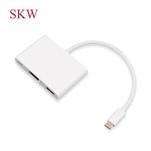

The most common HDMI interface is TYPE A, with a width of 13.9mm and a total of 19 pins. There is also a dual-link TYPE B interface that is rare, with a width of 21.2mm. HDMI uses 4 parallel TMDS differential signal channels, and the transmission link consists of three data channels and one clock channel.
Three of the data channels are used to transmit red, green, and blue data signals, and the fourth channel is used to transmit the clock, and its clock frequency is 1/10 of the data rate. The TMDS technology used by HDMI, the differential signal common mode bias voltage is +3.3V, the port impedance is 50 ohms, the rated amplitude jumps to 500mV (+2.8V~+3.3V), and the voltage swing varies between 150mV~800mV .
In addition, HDMI also has DDC (display data channel) data and clock lines to transmit two-way communication signals and HDCP (high-bandwidth digital copyright protection) signal transmission. The DDC bus is the key to HDMI compatibility. If any device is not compatible with HDMI 1.3, the entire system will automatically be reduced to HDMI 1.2 or lower through the DDC channel to ensure compatibility. DDC is very busy in HDMI cables. They not only carry handshake communication data, but also continuously pass HDCP encryption keys. If HDCP is compatible, the digital signal encrypted by the key needs to be continuously decoded.